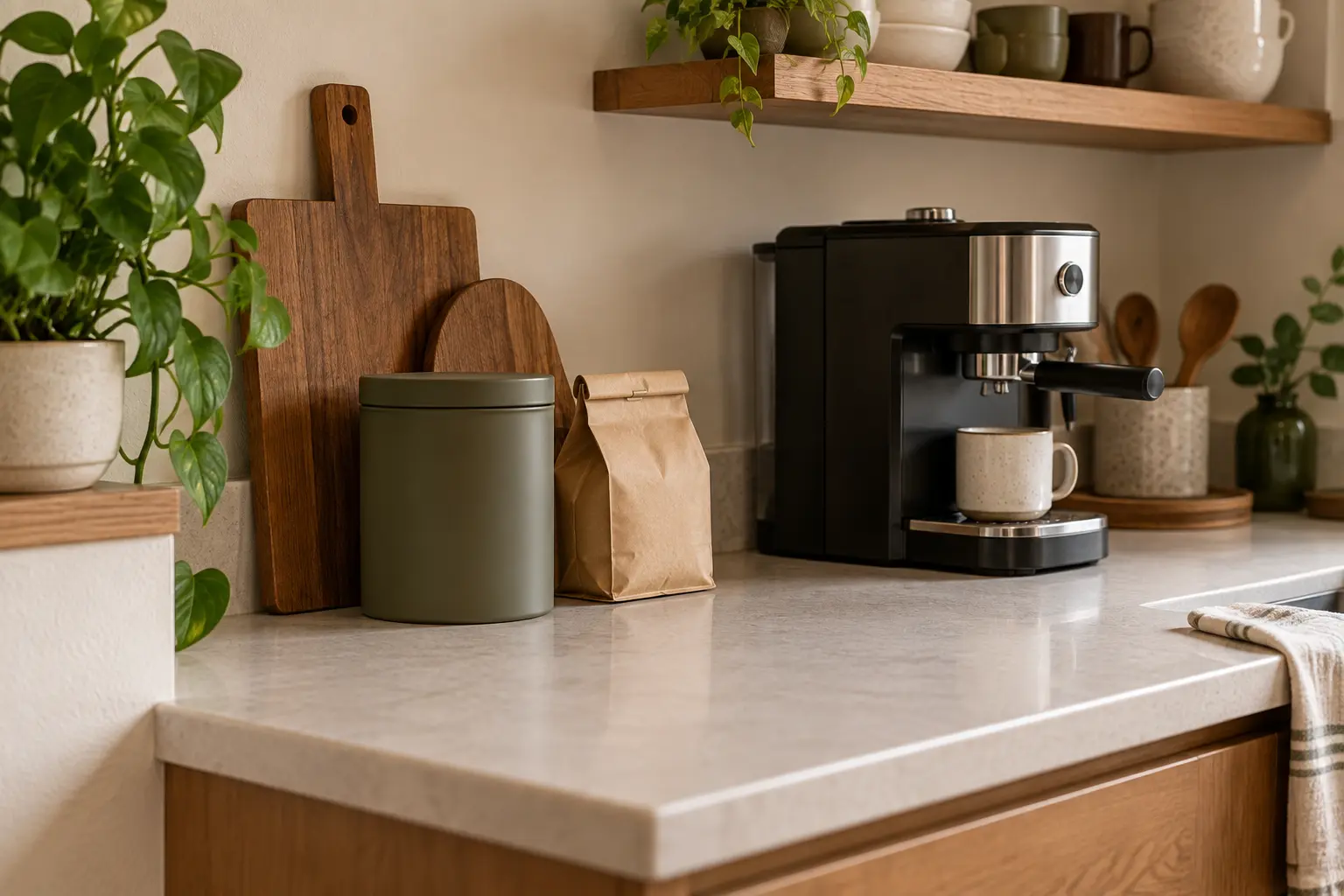
Coffee beans need a cool, dry and shaded home, but a small kitchen does not automatically need another decorative jar. A well-sealed original bag can work, as can an opaque airtight container. The best choice closes reliably, fits the measured space and is easy to refill without crowding the station.
Use this guide to choose a working quantity, compare storage methods and keep beans away from excess light, heat and moisture. Test the setup with what you own before shopping.
Disclosure: This post may contain affiliate links. If you buy through one of these links, we may earn a commission at no extra cost to you.
1. Start with the amount you actually use
Begin with your normal daily dose and a realistic refill interval. If a household uses 20 grams of beans per day and refills weekly, 20 grams × 7 days gives a hypothetical working supply of 140 grams. This is a planning example, not a freshness promise.
Do not convert bean weight directly into container volume. Roast level, bean size and headspace affect how much fits. Use package and container guidance, leaving room for the lid or vacuum mechanism to work correctly.
A smaller working supply is easier to place. Keep unopened bags or extra coffee in one backup area rather than forcing a bulk purchase onto the counter.
2. Compare three practical storage methods
There is no single container every small kitchen needs. Compare the routine as well as the object.
| Method | Best when | Check before choosing |
|---|---|---|
| Resealed original bag | The package closes securely and fits a shaded cabinet | Closure, damage, label retention and easy pouring |
| Opaque airtight container | You want a simple reusable home away from light | Exterior size, lid seal, opening clearance and cleaning instructions |
| Vacuum canister | You use whole beans and will maintain the mechanism | Bean-only compatibility, exact variant, seal care, exterior size and lid access |
The original bag keeps roast, origin and storage information with the coffee. If it closes well and stands securely in a cabinet, transferring beans may add work without solving a problem.
An opaque airtight container can offer easier access. A vacuum canister adds a mechanism that requires correct operation and care. Avoid guaranteed freshness multipliers; performance still depends on the coffee, closure, environment and handling.
3. Match container size to the shelf and the bag
Measure available width, depth and height, then add room to open the lid, reach inside or pour. Check cabinet-door movement and the path your hand takes when lifting the container out.
A canister may fit a shelf but remain awkward if its lid hits the shelf above. A wide container may leave too little grip room. A tall one may block an appliance reservoir or cabinet door.
Test a paper footprint, mark full height with removable tape and practice removing the mock container while nearby doors and appliances are in normal positions. This is more useful than choosing by liters alone.
4. Choose one practical storage location
A shaded cabinet
A cabinet near the coffee maker balances access and protection. Place beans where the container can be lifted without moving unrelated items. Keep cleaning products separate.
A pantry shelf
A pantry works for backup bags or a working container when it remains easy to reach. Avoid spreading half-open packages across several shelves.
A shaded counter edge
The counter can work when the container is opaque, stable and away from a sunny window, sink, stove and hot exhaust. Preserve a clear mug landing area. If the container consumes the last useful section, move it into a cabinet.
A stable cart shelf
A cart can hold coffee below the brewing surface. Confirm that the shelf is away from heat and steam and that the container cannot slide. For broader options, see Coffee Bar Storage Ideas Without More Counter Space.
A drawer with enough clearance
A deep drawer may hold a secure bag or correctly sized container. Check lid access and drawer closure. Do not stack heavy objects above a fragile container.
5. Separate the working supply from backup coffee
The station should support the current routine, not become a bulk pantry. Keep one manageable supply close and move unopened or extra bags to one backup location.
Retain roast, open and product information. If you transfer beans, use a removable note. Finish the older supply before opening another comparable bag, and do not combine batches merely to fill a display container.
This daily-versus-backup approach also works for filters, mugs and sweeteners. Coffee Station Organization Ideas for Small Spaces applies it to the whole station.
6. Make refilling and cleaning easy
Choose a simple refill point, such as when the working supply is nearly empty. Wipe loose chaff or beans from the shelf before replacing the container.
Follow the maker's cleaning instructions. Let washed parts dry completely, protect integrated mechanisms from water when required and inspect seals as directed.
Do not top up indefinitely. Finishing older beans first clarifies what is inside and creates a natural cleaning opportunity.
7. Avoid common storage mistakes
- Buying an oversized display jar that occupies the serving area
- Placing clear glass in strong daylight for appearance alone
- Storing beans above a steaming brewer, beside the stove or near the sink
- Treating liters as a precise conversion for every roast and bean density
- Using a vacuum mechanism for grounds when the maker specifies whole beans only
- Refilling a container before it is fully dry
- Stacking containers where removing one makes the others unstable
- Discarding the package before recording useful roast and storage information
A calm coffee corner comes from fewer reliable steps, not matching every container. Coffee Bar Essentials for Small Spaces can help decide what deserves permanent room.
8. When a vacuum canister is worth comparing
A vacuum canister may be worth comparing when you regularly use whole beans and will maintain its valve or pump. It is not required. A resealed bag or opaque airtight container may remain simpler.
Check the exact model rather than the family name. Manual and electric lids, materials and sizes can differ. Confirm exterior measurements, usable capacity, whole-bean compatibility, washing instructions and lid clearance. Do not use grounds or fine powders in a mechanism that warns they can clog its valve.
If beans sit beside an espresso setup, keep the container near the grinder without blocking water access, controls or the working area. Simple Espresso Corner Setup for Beginners covers the wider workflow.
Frequently asked questions
Can I keep coffee beans in the original bag?
Yes, when the bag closes securely, is undamaged and stays in a cool, dry, shaded place. It also preserves roast and product information. Place an unstable bag inside a simple bin.
Is a clear glass jar suitable for coffee beans?
Clear glass may expose beans to more light. Place one inside a shaded cabinet rather than in a sunny display position. An opaque container is easier to use on an exposed counter.
Can ground coffee use the same vacuum canister?
Only when the manufacturer allows it for that exact model. Some mechanisms are designed for whole beans and warn that grounds or fine powders can clog the valve.
How much coffee should stay at the station?
Keep the amount used during a comfortable refill interval. Multiply the normal daily dose by days between refills as a planning estimate, then compare it with package and container guidance. It is not a universal freshness deadline.
Is a cabinet better than the counter?
A shaded cabinet reduces light exposure and protects working space. A counter may be convenient when the container is opaque, stable and away from sunlight, water, heat and steam. Choose the location you can reset consistently.
Final thought
Good small-kitchen coffee bean storage starts with one manageable supply, one measured location and a closure you will use correctly. Test the footprint at home, keep the serving area clear and buy a container only when it solves a specific problem.